Golden Sun Moth
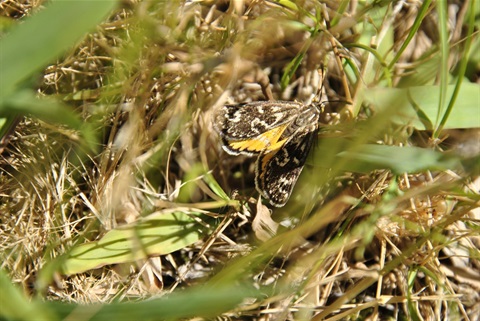
A tiny moth with a big role in our local grasslands
You might not expect a moth to be one of Wangaratta's most important native animals, but the Golden Sun Moth (Synemon plana) is exactly that. This threatened species is found across south eastern Australia, and it depends on a type of grassland that has almost disappeared, with less than 1% of Victoria's original native temperate grasslands still remaining. Right here in Wangaratta, the moth has been recorded in the native grassland behind the Barr Reserve, which is why the site is so carefully looked after.
What does it look like?
It's small, with a wingspan of around 3 to 3.5 centimetres, and unlike most moths, it flies during the day. Females have bright golden orange hindwings dotted with black spots, while males are more understated, with bronze brown hindwings and darker forewings. You'll usually spot them flying low over the grass on warm, sunny days.
Adult moths live for only one to four days and don't even have working mouthparts, so they never eat. Their entire adult life is dedicated to one thing, finding a mate and starting the next generation.
A life spent mostly underground
Seeing a Golden Sun Moth means witnessing the last chapter of a much longer story. After mating, females lay their eggs at the base of grass tussocks. The eggs hatch after around three weeks, and the larvae then spend two to three years underground, feeding on the roots of native grasses before finally emerging as adults.
Emergence usually happens from mid November to late December, though it can start as early as mid October and run through to early January. So while the moths are only visible for a few weeks each year, their habitat needs protecting all year round.
Why the grassland matters
Golden Sun Moths rely on native grassland, particularly Wallaby Grass (Rytidosperma species), which feeds the larvae underground. Native temperate grasslands are some of the rarest ecosystems left in Victoria, home to many other threatened plants and animals.
These grasslands aren't simply paddocks left to grow wild. They are living ecosystems, shaped and cared for by Traditional Owners over countless generations through cultural fire and other traditional land management practices. In Bangerang language, the moth is known as Yurrnga Ganbina, part of the native grassland community of Bangerang Country and carrying a deep connection to Country and traditional knowledge.
Why does Council manage this patch differently?
The grass behind Barr Reserve doesn't always get the same treatment as other open spaces, and that's intentional. The moth needs native grass tussocks, but if growth or plant litter build up too much, adult moths struggle to emerge, find each other and lay eggs. Carefully timed slashing or burning helps keep the habitat healthy, while weed control, vehicle access and soil disturbance are managed to avoid harming the grasses and larvae below.
During the moth's flight season, Council avoids mowing and slashing altogether, so the moths can emerge, mate and lay their eggs undisturbed. If the grass looks a little long at times, that's a sign the system is working, not a sign it's been forgotten.
Can you see one for yourself?
Your best chance is during the flight season, roughly mid November to late December, on warm to hot, sunny days between about 10am and 3pm.
If you spot one, enjoy it from a distance and avoid walking through the grassland. Adult moths only live a few days, and females don't move around much, so even a small patch of undisturbed grass can matter to the species' survival.
Help us protect Yurrnga Ganbina
If you spot a Golden Sun Moth, consider logging it on iNaturalist, as community sightings help build a clearer picture of where threatened species occur. Most of all, you can help by staying out of the habitat, keeping vehicles off the site, and letting Council's ongoing vegetation management program do its job.
Want to know more?
For more detail download our Golden Sun Moth brochure(PDF, 873KB).